


If you are planning a trip to Tokyo and want a panoramic skyline experience that is equal parts art, architecture, and genuine wonder, Tokyo City View at Roppongi Hills Mori Tower belongs at the top of your list. Perched on the 52nd floor at 250 metres above sea level, this glass-walled observation deck delivers a full 360-degree sweep of the Japanese capital from Tokyo Tower glowing in the immediate foreground to Mount Fuji on the horizon on a clear winter morning. Whether you are visiting for the sunset, the night skyline, or as part of a curated private tour, this guide gives you everything you need to plan your visit with confidence.
Tokyo City View is one of the few observation decks in Tokyo where you can arrive at golden hour, linger through the blue hour, and stay until the city is fully ablaze with light all from a calm, comfortable, indoor space with no fixed time limit on your visit.
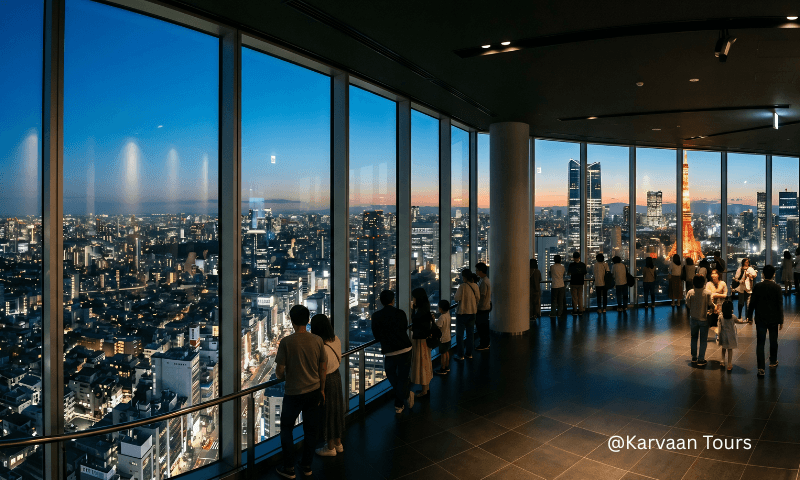
Tokyo City View observation deck at Roppongi Hills Mori Tower with panoramic city skyline
What Is Tokyo City View at Roppongi Hills Mori Tower?
Tokyo City View is the observation facility on the 52nd floor of Mori Tower, the centrepiece skyscraper of the Roppongi Hills complex in Minato City, central Tokyo. The deck sits 250 metres above street level, wrapping the full circumference of the tower with floor-to-ceiling glass panels that rise 11 metres high, giving completely unobstructed sightlines in all directions.
The venue is considerably more than a standard lookout point. The Sky Gallery zones inside the deck host rotating curated art exhibitions throughout the year, meaning the cultural experience changes on each visit. The 53rd floor, directly above, houses the internationally recognised Mori Art Museum, accessible with a combined ticket, making the two together one of the most complete art-and-cityscape destinations in Japan.
Mori Tower sits at the heart of the broader Roppongi Hills destination, which includes luxury dining, the Grand Hyatt Tokyo, the Roppongi Hills Arena event space, and the Keyakizaka promenade, one of Tokyo's most celebrated seasonal evening walks, particularly dazzling during the Christmas illumination period.
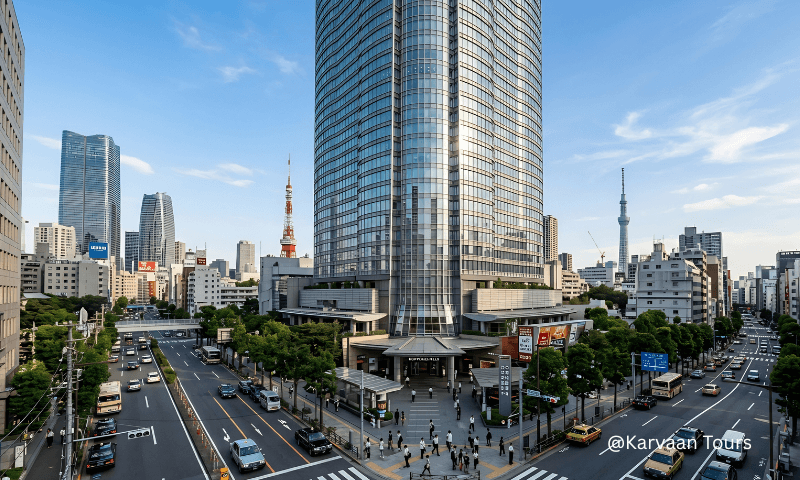
Roppongi Hills Mori Tower exterior home to Tokyo City View observation deck, Minato City Tokyo
Tokyo City View Ticket Price Guide 2026
Tickets are tiered by visitor age, purchase channel, and the exhibition running at the time of your visit. Buying online in advance saves you money per person and removes the need to queue at the on-site ticket counter on the day.
|
Visitor Type |
On-Site Price |
Online Price |
|
Adult (18–64) |
¥2,400 – ¥2,600 |
¥2,200 – ¥2,300 |
|
Senior (65+) |
¥2,100 |
¥1,900 |
|
University / High School Student |
¥1,700 |
¥1,600 |
|
Child (Age 4 – Junior High) |
¥1,100 |
¥1,000 |
|
Child (Age 3 and under) |
Free |
Free |
|
Group (15+ adults, advance only) |
¥2,000 |
— |
Note: Prices vary depending on the current exhibition period. The ranges above reflect standard 2026 admission. Always confirm current pricing at the official Tokyo City View website before your visit.
Advance tickets can be purchased through the official Roppongi Hills online booking portal or through authorised resellers. The entrance is on the 3rd floor of Mori Tower (the Museum Cone lobby), with high-speed elevators taking you directly to the 52nd floor.

Opening Hours: Daily 10:00 – 22:00. Last admission 21:30. Hours may be extended during seasonal events such as Christmas in the Sky (mid-November through 25 December).
Best Time to Visit Tokyo City View for a Sunset Viewing Experience
Timing your visit around sunset is the single most effective way to maximise what Tokyo City View offers. The transition from golden-hour light through the blue hour and into full night with Tokyo Tower's amber illumination blazing in the foreground is the experience that defines this deck for most visitors. There is no time limit once inside, and the space has ample seating, so there is every reason to arrive early and stay late.
Here is a practical guide to arrival times by season:
|
Season |
Approx. Sunset Time |
Recommended Arrival |
|
Winter (Dec – Jan) |
4:28 PM – 4:43 PM |
By 3:00 PM |
|
Spring (March) |
5:42 PM – 5:55 PM |
By 4:15 PM |
|
Late Spring / Summer (May – Jul) |
6:33 PM – 7:00 PM |
By 5:00 PM |
|
Autumn (Sep – Oct) |
5:15 PM – 5:36 PM |
By 4:00 PM |
|
Late Autumn (November) |
4:30 PM – 4:39 PM |
By 3:00 PM |
Aim to arrive at least 75 to 90 minutes before sunset. Use the first 30 minutes to walk the full 360-degree deck in daylight, then settle at your preferred window for the golden hour. Stay through the blue hour, the 30-to-45-minute window after sunset when the sky holds colour and Tokyo Tower's lighting switches on and continue into full dark for the complete experience.
For the most relaxed visit, weekday mornings (10:00 AM to noon) and weekday evenings after 8:30 PM are consistently quieter. The busiest periods are weekend sunsets, Golden Week (late April to early May), cherry blossom season (late March to early April), and the Roppongi Hills Christmas illumination period.
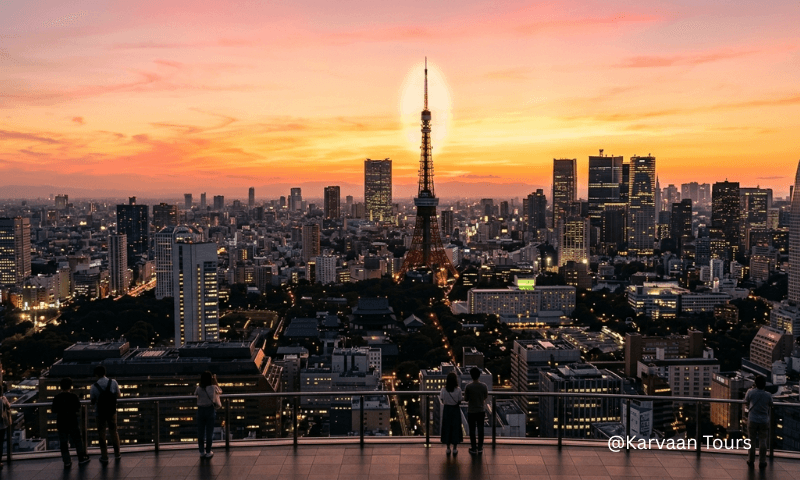
Sunset view from Tokyo City View Roppongi Hills Tokyo Tower and panoramic cityscape at golden hour
Can you see Mount Fuji from Tokyo City View?
Yes, though visibility depends on season, time of day, and atmospheric conditions. Mount Fuji is visible from Tokyo City View on roughly 20 to 30 percent of days per year, and the window narrows considerably during warmer months.
The clearest conditions occur between late November and February, when cold, dry air reduces haze across the Kanto plain. Early morning from the 10:00 AM opening through mid-morning offers the highest likelihood, as urban haze tends to build through the afternoon and can obscure the view by evening.

From the deck, Fuji sits to the west-southwest, appearing above the Shibuya and Shinjuku skylines. On the clearest days, the snow-capped peak is unmistakable on the horizon. Before your visit, a quick check of a live Fuji webcam service can give you a reliable indication of whether visibility conditions are favourable that morning.
Mount Fuji Visibility at a Glance
- Best months: December and January (highest probability over 60% on clear-air days)
- Good months: November and February
- Difficult months: June through September (rainy season and summer haze)
- Best time of day: Early morning (open from 10:00 AM)
- Direction from the deck: West-southwest, beyond the Shibuya/Shinjuku skyline
Travelling in winter and Fuji is a priority?
Our team can plan a flexible morning visit in November through January and pair it with a contingency activity on the same day so your itinerary is not dependent on a single weather window.
Speak to Karvaan Tours about your Tokyo itinerary →
What Does the Tokyo Skyline Look Like from Roppongi Hills?
Because Tokyo City View sits in the geographic heart of central Tokyo rather than at the city's edge, the panorama it provides is genuinely 360 degrees of dense, layered urban cityscape. Each direction tells a distinct part of the city's story.
• South: Tokyo Tower fills the frame at unusually close range; its red and white lattice structure is lit in warm amber from sunset through midnight. Beyond it, Zojoji Temple, Shiba Park, Tokyo Bay, Rainbow Bridge, Odaiba, and Haneda Airport approach paths are visible.
- East: The Ginza and Tsukiji skylines give way to the distant silhouette of Tokyo Skytree, Japan's tallest structure at 634 metres, visible on the horizon.
- North / Northeast: The Akasaka and Toranomon corridors, including the new Azabudai Hills Mori JP Tower (Tokyo's current tallest building), Ikebukuro's Sunshine 60, and the National Diet Building.
- Northwest: The Shinjuku skyscraper cluster, including the Tokyo Metropolitan Government Building and NTT Docomo Yoyogi Tower, forms one of Asia's most dramatic high-rise groupings.
- West / Southwest: Shibuya Scramble Square, Yoyogi Park, the forest canopy of Meiji Shrine, and on clear days the snow-capped silhouette of Mount Fuji above the horizon.
A free multilingual landmark orientation guide is available at the entrance. QR codes at key windows inside the deck provide additional identification of visible structures.
Tokyo City View Indoor Observation Deck vs Sky Deck: What You Need to Know in 2026
Many travellers arrive expecting access to both an indoor observation floor and an outdoor rooftop. It is important to understand the current situation before you plan.
Tokyo City View 52nd Floor Indoor Deck
The main observation experience. A fully enclosed, climate-controlled gallery wrapping the 52nd floor with glass walls 11 metres high. Offers clear 360-degree views, comfortable bench seating throughout, café service, rotating art installations, and a gift shop. Open to the public daily.
Sky Deck Outdoor Rooftop
The outdoor rooftop Sky Deck has been permanently closed to the general public since April 2024, per an official notice from Mori Building. As of 2026, no reopening date has been announced. Any listing still advertising rooftop access at Tokyo City View should be considered outdated.
The practical effect on your visit is minimal. The difference in altitude between the indoor deck and the former rooftop is imperceptible at this height. The glass-enclosed environment is arguably a superior experience for most visitors, offering comfort in any weather, seating for extended stays, and unimpeded photography from pressed-glass positions.
How Tokyo City View Compares to Other Tokyo Observation Decks?
Choosing the right observation deck for your Tokyo itinerary depends on what experience you are prioritising. Here is a clear comparison of the main options in 2026:
|
Observation Deck |
Height |
Adult Ticket (Online) |
Style |
Best For |
Booking |
|
Tokyo City View (Roppongi Hills) |
250 m / 52F |
¥2,200 – ¥2,300 |
Indoor, 360°, glass-walled |
Close-up Tokyo Tower; sunset & art combo; relaxed atmosphere |
Usually available same-day |
|
Tokyo Skytree Tembo Deck |
350 m |
from ¥2,100 (weekday) |
Indoor, 360° |
Maximum altitude; best Fuji odds; family activities |
Book ahead to save |
|
Tokyo Skytree Tembo Galleria |
450 m |
¥3,100 – ¥3,800 |
Indoor spiral |
Highest public view in Tokyo |
Book ahead for weekends |
|
Shibuya Sky |
229 m / 47F |
¥2,500 (online) |
Open-air rooftop |
Instagram sunset above Shibuya Crossing |
Book 2–4 weeks ahead; sells out |
|
Tokyo Tower Top Deck Tour |
250 m |
¥3,000 – ¥3,300 |
Indoor, guided |
Premium experience inside the icon |
Moderate lead time |
|
Tokyo Metropolitan Govt Building |
202 m |
Free |
Indoor, daytime |
Budget-friendly; daytime Fuji views from Shinjuku |
Walk-in |
Our recommendation for first-time Tokyo visitors:
A private sunset experience at Tokyo City View followed by a Roppongi Hills Keyakizaka illumination stroll delivers one of the most memorable evenings in Tokyo, without the last-minute booking pressure of busier alternatives. Our private guided tours handle every detail.
Explore Karvaan's Tokyo Private Tour Options →
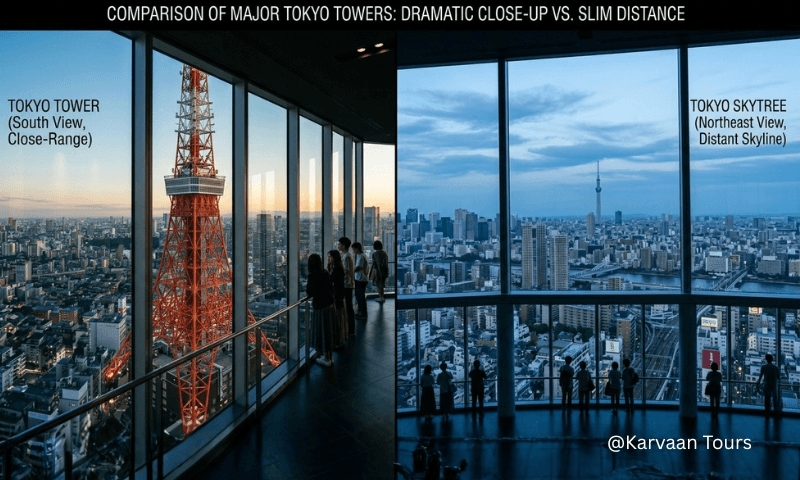
Tokyo observation deck comparison: Tokyo Tower close-up from Roppongi Hills vs Tokyo Skytree on the horizon
Night Photography Tips for Tokyo City View
Tokyo City View after dark is one of the most photographically rewarding destinations in Japan. The close proximity to Tokyo Tower its amber illumination sweeping across the glass windows from sunset through midnight combined with the depth of the city below creates a scene that rewards patient composition.
Important 2026 Update: Tripods and monopods have been prohibited at Tokyo City View since June 2025. Lockers are available at the entry floor for a refundable small deposit. Plan your equipment accordingly.
Managing Glass Reflections
The single most effective technique at any glass-walled deck: press your lens hood, lens barrel, or a folded jacket flat against the glass. This blocks interior light sources and eliminates the majority of reflections in your frame. Even a cupped hand around the lens works well.
Camera Settings for Handheld Night Shots
- Use f/1.4 – f/2.8 with ISO 1600 – 6400 and a shutter speed of 1/60 or faster
- Shoot in RAW for maximum recovery in post-processing
- Smartphone users: activate Night Mode and press the camera flat to the glass, holding still for the 2–3 second exposure
- Modern flagship phones (iPhone 15 Pro, Pixel 8, Samsung S24 series) produce excellent results here
Best Windows and Zones on the Deck
- South side (Tokyo Tower): The signature shot. Position slightly to the left of each window midpoint to minimise light pillar reflections from the dividing frame.
- West side (Shibuya/Shinjuku direction): Best for sunset silhouettes and Mount Fuji shots on clear winter mornings.
- Northeast (Skytree direction): Most rewarding in the 30 minutes after full dark, when both Tokyo Tower and Skytree are simultaneously illuminated.
- Sky Gallery zones: Rotating light installations inside the deck often create striking composite reflections in the outer glass.
Timing Your Photography Session
- Arrive 90 minutes before sunset for full-circumference, daytime scouting
- Settle at your chosen window 45 minutes before sunset
- Shoot continuously through sunset, blue hour, and the first 30 minutes of full darkness
- Break at the on-floor café, then return for final night shots before last admission at 9:30 PM
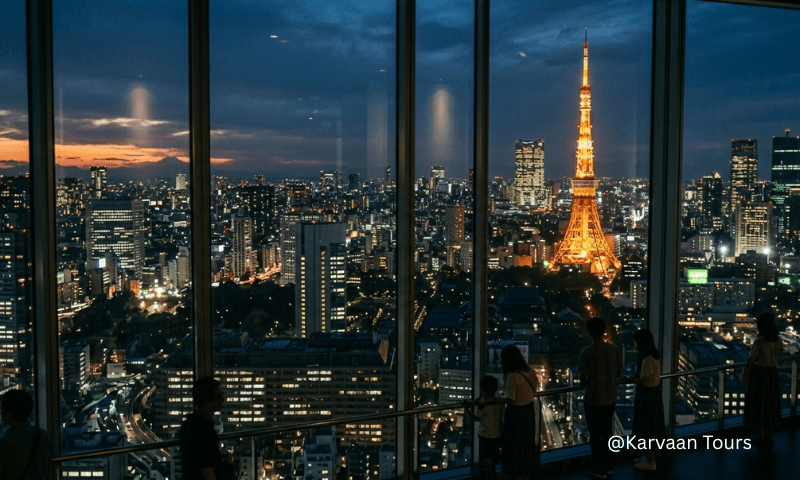
Tokyo City View night photography: Tokyo Tower illuminated at night from Roppongi Hills Mori Tower observation deck
Is Tokyo City View a Good Experience for Couples and Special Occasions?
Tokyo City View is one of the most romantic observation experiences in all of Japan. The calm, unhurried atmosphere, the absence of wind exposure, and the unmatched spectacle of Tokyo Tower glowing in the immediate foreground make it a naturally special setting for anniversaries, proposals, and birthday evenings.
Why Couples Choose Roppongi Hills for Their Tokyo Evening
- Tokyo Tower's night illumination amber floodlights from sunset until midnight create the most cinematically beautiful backdrop in modern Tokyo for couple photography.
- The on-floor café (The Sun & The Moon) offers window-seat seating with unobstructed views, ideal for a relaxed drink or light meal while watching the city transform from golden to electric.
- No fixed duration: you can stay until last admission at 9:30 PM without any time pressure.
- During Christmas in the Sky (mid-November to 25 December), the deck is decorated seasonally, and Roppongi Hills Keyakizaka below is illuminated with approximately 700,000 LED lights, one of the most beloved date walks in Tokyo.
- Unlike busier, windier alternatives, Tokyo City View allows couples to move at their own pace, choose their window, and take photographs without queuing.
Planning a proposal, anniversary, or birthday evening in Tokyo?
Our team at Karvaan Tours can coordinate window-seat restaurant reservations, a private English-speaking guide for your visit, and optional photographer positioning – transforming Tokyo City View into a complete, unforgettable evening rather than a single attraction.
Contact Karvaan Tours to Plan Your Special Occasion →
Real Visitor Experiences at Tokyo City View
Travellers from around the world consistently describe Tokyo City View as one of the standout moments of their Japan trip not just for the views but for the quality of time it allows.
Many visitors note the contrast with larger, louder observation decks: the space at Roppongi Hills is generous enough to find uncrowded windows, walk at leisure, and spend an hour watching the light shift without feeling hurried. Families with young children appreciate the indoor environment, the available seating, and the absence of wind or cold exposure. Photographers working handheld since the tripod policy change consistently produce striking results using the glass-pressed technique.
For travellers on a first visit to Tokyo, Tokyo City View is frequently described as the moment the city's true scale becomes tangible, the point at which the grid of lights, highways, and towers below stops being a map and becomes a lived experience.
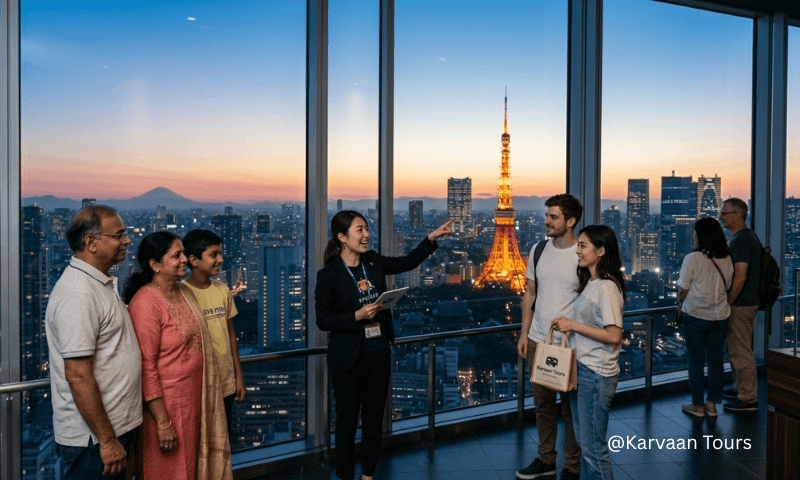
Karvaan Tours Japan private guided experience at Tokyo City View Roppongi Hills observation deck
Experience Tokyo City View with Karvaan Tours Japan
At Karvaan Tours Japan, we believe the difference between a good trip and a truly memorable one is in the curation. Tokyo City View is a world-class experience on its own, but arriving at the right time, with a knowledgeable guide beside you and every detail handled in advance, transforms it into one of the defining moments of a Japan journey.
Our private Tokyo tours that include a Tokyo City View visit are built around your schedule, group size, and specific interests. We manage advance ticket booking, transport from your hotel, and guided landmark orientation inside the deck and can connect your evening to dinner, illumination walks, or further exploration of the Roppongi Hills galleries and dining district.
Whether you are travelling as a couple, a family, a small group of friends, or on a corporate programme, every Karvaan itinerary is designed from scratch.